
Here is an uncomfortable fact for anyone who has built or invested in an AI company: the model itself may be the hardest thing in the business to own. No U.S. court has yet recognized copyright in trained model weights, which are produced by an optimization process rather than written by a human author. The outputs fare no better. In March 2026 the Supreme Court declined to review Thaler v. Perlmutter, leaving in place the D.C. Circuit’s holding that the Copyright Act requires a human author. Even the industry’s vocabulary resists ownership; the USPTO refused to register “GPT” as merely descriptive.
What an AI company can own is what users see. The prompt window and the screens around it, the avatar or animation that gives a model its personality, and the visual frame in which its work is delivered are all visual design, and visual design is governed by three well-developed bodies of law: design patents, copyright, and trade dress. As models become more interchangeable, those visual surfaces may become the most durable part of an AI company’s competitive position.
None of this is new terrain. Courts spent three decades working out how these regimes apply to desktop software, websites, and smartphones. Read alongside a cluster of 2025 and 2026 developments, that history gives AI companies a surprisingly clear playbook. It also exposes one trap that is unique to companies that design with AI.
We Have Been Here Before
Two Apple cases bracket the history. In Apple Computer, Inc. v. Microsoft Corp., 35 F.3d 1435 (9th Cir. 1994), Apple tried to use copyright to protect the “look and feel” of the Macintosh interface. The Ninth Circuit took the interface apart, filtering out overlapping windows as standard features of any windowing system and treating a page-shaped document icon as an idea merged with its expression. What remained received only thin protection against virtually identical copying. Apple, the court said, could not obtain patent-like protection for the idea of a graphical user interface.
Twenty years later Apple returned with a different toolkit. In Apple Inc. v. Samsung Electronics Co., 786 F.3d 983 (Fed. Cir. 2015), it asserted both design patents and trade dress in the iPhone’s appearance, including its grid of rounded, colorful icons. The Federal Circuit upheld the design patents but reversed the trade dress verdict entirely. Icons, the court reasoned, are visual shorthand that make the phone easier to use, and the claimed screen was an assemblage of functional parts.
The same screen produced two opposite results because each regime applies its own functionality test, and the tests are not equally forgiving. A design patent fails only if the design is “primarily functional,” meaning dictated by function because no alternative designs are available. High Point Design LLC v. Buyers Direct, Inc., 730 F.3d 1301 (Fed. Cir. 2013); Best Lock Corp. v. Ilco Unican Corp., 94 F.3d 1563 (Fed. Cir. 1996). Trade dress fails if a feature has some utilitarian advantage, or if exclusive rights would put competitors at a significant disadvantage unrelated to reputation. TrafFix Devices, Inc. v. Marketing Displays, Inc., 532 U.S. 23 (2001); Qualitex Co. v. Jacobson Products Co., 514 U.S. 159 (1995). Copyright filters out methods of operation, merged ideas, and stock elements before it protects anything. Design patents tolerate function best; trade dress tolerates it least.
Several other lessons from the earlier era carry forward. The regimes can be stacked: a design patent does not bar trade dress in the same design, In re Mogen David Wine Corp., 328 F.2d 925 (C.C.P.A. 1964), and is some evidence that the design is not functional, In re R.M. Smith, Inc., 734 F.2d 1482 (Fed. Cir. 1984). A utility patent cuts the other way; under TrafFix it is strong evidence of functionality. Interface trade dress must be defined precisely. Ingrid & Isabel, LLC v. Baby Be Mine, LLC, 70 F. Supp. 3d 1105 (N.D. Cal. 2014), held that a website’s look and feel can be protected, but only where the plaintiff identifies specific elements rather than cataloguing features. And trademark law cannot be stretched to protect content. Dastar Corp. v. Twentieth Century Fox Film Corp., 539 U.S. 23 (2003), forbids using the Lanham Act as a “mutant copyright” over communicative works, while state-law copying claims aimed at a website’s look and feel are generally preempted by the Copyright Act. Blue Nile, Inc. v. Ice.com, Inc., 478 F. Supp. 2d 1240 (W.D. Wash. 2007).
Three Layers of an AI Platform
Applied to AI, these lessons sort naturally into three visual layers: the interface the user sees and touches, the way the model itself appears, and what the model produces. Each layer calls for a different combination of protections. To make the analysis concrete, the figures below use a fictional platform, Fennick, whose interface, persona, and outputs were designed for this article.
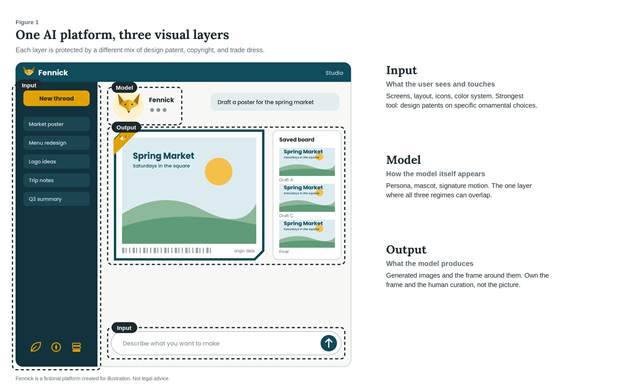
Figure 1. A fictional AI platform, Fennick, divided into its three visual layers. Figures 2 through 4 apply the law to each layer.
The Input Layer: Today’s iPhone Home Screen
Figure 2. The input layer. Design patents protect the ornamental arrangement and icon art; trade dress protects only the arbitrary styling; usability features are weak or functional.
The AI chat window is this decade’s iPhone home screen. Its standard parts, including the prompt box, the conversation history in a sidebar, the chat bubbles, and the model selector, help users operate the product. Under Apple v. Samsung, a company that claims trade dress in those features should expect to lose on functionality. Under Apple v. Microsoft, it should expect copyright to treat them as the overlapping windows of the AI era. The industry’s favorite visual shorthand presents the same problem from another direction: when nearly every major platform marks its AI features with a sparkle icon, the sparkle signals a category of product, not a particular source.
Design patents are the strongest tool at this layer, and they recently became stronger. On March 13, 2026, the USPTO issued supplemental guidance for computer-generated interfaces and icons, 91 Fed. Reg. 12,394, that removes the long-standing requirement to depict a display screen in the drawings. Claims to a “graphical user interface for a computer” or a “computer icon” are now acceptable, and projected, virtual reality, and augmented reality interfaces are eligible. Animated interfaces rest on older footing: In re Hruby, 373 F.2d 997 (C.C.P.A. 1967), held that a design composed entirely of moving water could be patented, and the USPTO has long granted design patents on animated interfaces shown as a sequence of images. The guidance did not eliminate the need to name an article of manufacture, and Curver Luxembourg, SARL v. Home Expressions Inc., 938 F.3d 1334 (Fed. Cir. 2019), confirms that the named article defines the patent’s scope.
Two recent decisions mark the boundaries. Shunock v. Apple, Inc., 825 F. Supp. 3d 366 (S.D.N.Y. 2026), which ended in summary judgment of non-infringement over Apple’s animated Activity Rings, held that infringement is judged by what appears during normal use, not by a powered-off device on a store shelf. That matters for any interface that exists only when software runs. But the same court applied the Federal Circuit’s en banc decision in LKQ Corp. v. GM Global Technology Operations LLC, 102 F.4th 1280 (Fed. Cir. 2024), to treat the relevant field for obviousness as graphic design generally, thereby widening the body of prior art against which a GUI patent must be evaluated. And in WePay Global Payments LLC v. McDonald’s Corp., 2022 WL 17279115 (N.D. Ill. Nov. 29, 2022), a patent on an animated interface built from unadorned squares and circles was dismissed as the antithesis of what a design patent protects. The lesson for AI companies is to patent rich, specific ornamental choices, not generic layouts. Companies should also watch the Federal Circuit, where amicus filings in pending appeals urge doctrines that could narrow how design patents are enforced, even as the USPTO broadens what it will grant.
Trade dress still has a role at the input layer, but only for the arbitrary layer of the design: a particular color system, typeface, illustration style, and their arrangement, defined with the precision Ingrid & Isabel requires. Marketing discipline matters here as much as drafting. In Weems Industries, Inc. v. Teknor Apex Co. (8th Cir. July 30, 2026), a registered color mark on garden hoses was cancelled as functional after the owner’s own advertising touted the color’s visibility, and the court affirmed a fee award of roughly $3 million. An AI company that advertises its interface design as making prompting faster or easier is writing the same evidence against itself.
The open question that could change the economics
Design patents carry a remedy no other visual regime offers. Under 35 U.S.C. § 289, an infringer is liable for its total profit on the “article of manufacture” to which the design is applied, without apportionment. In Samsung Electronics Co. v. Apple Inc., 580 U.S. 53 (2016), the Supreme Court held that the article can be a component rather than the entire product, but declined to say how to identify it. On remand, the district court adopted a four-factor test that looks to the scope of the claimed design, its prominence within the product, whether it is conceptually distinct from the product, and its physical relationship to the rest of the product. Apple Inc. v. Samsung Electronics Co., 2017 WL 4776443 (N.D. Cal. Oct. 22, 2017). Later courts have applied the test with results ranging from a single component to an entire product. MCP IP, LLC v. .30-06 Outdoors, LLC, 643 F. Supp. 3d 800 (S.D. Ohio 2022).
No court has yet applied that test to an interface delivered purely as software or as an online service. Shunock presented the question but was resolved on non-infringement. For an AI company, the answer could be decisive. If a competitor copies a patented chat interface, the article of manufacture might be the interface, the application, or the subscription service the interface is sold with. A court that accepted the broader view would open a damages base that no copyright or trade dress claim could reach. That uncertainty is, by itself, a strong reason to file.
The Model Layer: Give the Model a Face
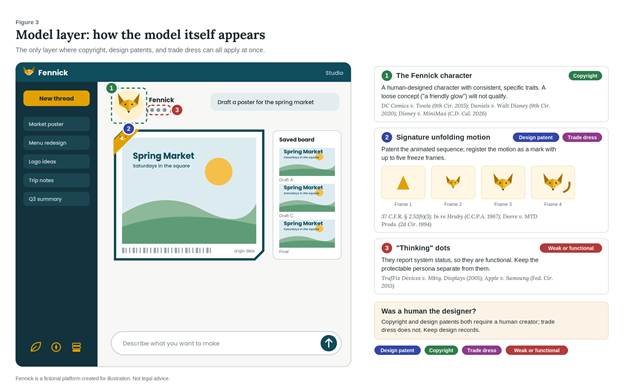
Figure 3. The model layer. The persona can be a copyrighted character, its signature motion can be patented and registered as a mark, and the status indicator should be kept separate because it is functional.
The model layer is the most underused opportunity in AI intellectual property, and the only layer where all three regimes can fully overlap. A model’s visual persona, whether an avatar, a mascot, or a signature animated form, can be protected as a copyrighted character, as a design patent on its animation, and eventually as a trademark.
Character copyright is governed in the Ninth Circuit by DC Comics v. Towle, 802 F.3d 1012 (9th Cir. 2015), which protects a character apart from the works it appears in if it has physical as well as conceptual qualities, is sufficiently delineated to be recognizable wherever it appears, and is especially distinctive. Consistent traits matter more than consistent appearance; the court pointed to James Bond and Godzilla as characters that remain protected despite changing looks. The limit appears in Daniels v. Walt Disney Co., 958 F.3d 767 (9th Cir. 2020), where color-coded characters representing emotions were denied protection because their appearance shifted over time and their only consistent trait was an idea: using a color to represent a mood. An AI persona described as “a friendly blue glow that represents helpfulness” is closer to Daniels than to Towle. A protectable persona needs stable, specific traits.
The stakes became concrete this year. In Disney Enterprises, Inc. v. MiniMax, 2026 WL 1476670 (C.D. Cal. May 2026), the court applied Towle to an AI image and video generator and found it plausible that Disney’s characters were distinctive because typing a character’s name, with no further description, produced a near-perfect visual reproduction. The decision cuts both ways. It confirms that a well-delineated visual character can be enforced against AI reproduction, and it warns AI companies that their own tools can generate liability when they reproduce someone else’s.
A persona’s signature movement can also become a trademark. USPTO rules allow a motion mark to be depicted with up to five freeze frames and a written description. 37 C.F.R. § 2.52(b)(3). Like color, motion must ordinarily acquire distinctiveness before it is protected, and courts treat animation as a meaningful dimension of a mark; the Second Circuit enjoined a competitor’s animated alteration of John Deere’s leaping-deer logo in Deere & Co. v. MTD Products, Inc., 41 F.3d 39 (2d Cir. 1994).
The trap at this layer is the “thinking” animation. An indicator that tells users the model is working conveys operational status, which places it in the same category as the iPhone’s page dots that the Federal Circuit found functional. Companies should keep the persona separate from the status signal, and should never market the persona as telling users anything. A persona that conveys no information is the protectable kind.
The Output Layer: Own the Frame, Not the Picture
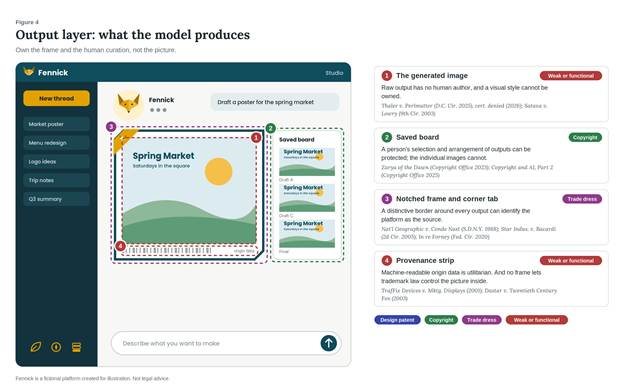
Figure 4. The output layer. The raw image and its provenance data are unprotectable or functional; the human-curated board and the distinctive frame are where ownership is possible.
Raw output is largely beyond the reach of copyright. Thaler v. Perlmutter, 130 F.4th 1039 (D.C. Cir. 2025), requires a human author, and the Copyright Office’s position is that prompts alone do not supply enough control over the result. Human contributions can still be protected. In Zarya of the Dawn, the Office registered the author’s selection, coordination, and arrangement of text and images while refusing protection for the individual AI-generated images, and its 2025 report confirms that creative selection, arrangement, and modification of outputs can be claimed. A platform’s visual style is not protectable either. Copyright protects specific expression, not a general look, Satava v. Lowry, 323 F.3d 805 (9th Cir. 2003); Steinberg v. Columbia Pictures Industries, Inc., 663 F. Supp. 706 (S.D.N.Y. 1987).
What an AI company can own at this layer is the consistent visual frame around its outputs. Courts have long protected distinctive borders and frames as trade dress, including the yellow rectangle of National Geographic, National Geographic Society v. Conde Nast Publications Inc., 687 F. Supp. 106 (S.D.N.Y. 1988). A border design can be protected in its own right if it creates a separate commercial impression, Star Industries, Inc. v. Bacardi & Co., 412 F.3d 373 (2d Cir. 2005), and packaging-type trade dress can be inherently distinctive under the Seabrook factors, In re Forney Industries, Inc., 955 F.3d 940 (Fed. Cir. 2020). A branded output frame or decorative watermark fits naturally within that line of cases.
Two limits apply. A watermark designed to carry machine-readable provenance information serves a utilitarian purpose and risks being held functional, so the source-identifying design should be kept separate from the verification mechanism. And Dastar forecloses using trademark law to control the image inside the frame. The frame identifies who delivered the content; it does not make the content the platform’s property. Where a competitor misdescribes the nature or origin of AI outputs, the better theory is false advertising under section 43(a)(1)(B), which Dastar left available.
The Trap Unique to AI Companies
Two of the three regimes require a human creator. Copyright requires a human author under Thaler v. Perlmutter. Patent law requires a human inventor under Thaler v. Vidal, 43 F.4th 1207 (Fed. Cir. 2022), and the USPTO’s November 2025 inventorship guidance confirms that the same standard applies to design patents. Trade dress has no such requirement; it asks only what consumers recognize.
AI companies are more likely than any other business to generate their own icons, animations, and mascots with AI tools. If they do, copyright and design patent protection both weaken, and only trade dress remains, which is the slowest of the three to develop. The remedy is unglamorous but important: keep human design records showing who conceived each visual asset, how drafts evolved, and who selected the final version. When registering copyrights, disclose AI-generated material as the Copyright Office requires and claim only the human contribution. These records deserve the same attention companies now give to the provenance of their training data.
A Practical Sequence
The three regimes work best as a sequence rather than as separate filings.
- Before launch, identify the few visual elements at each layer that the company wants users to recognize years from now, and confirm they are not standard features of AI products.
- Document human design authorship and inventorship for each of those elements from the start.
- File design patents on the distinctive interface, icons, and persona animations within the statutory grace period, drafted around specific ornamental choices.
- Register copyright in human-created character art, illustrations, and animation sequences early, so statutory damages and fees are available if they are copied.
- Keep usability claims out of marketing for any feature the company hopes to protect as trade dress, and keep status indicators separate from the persona.
- During the design patents’ term, build trade dress through consistent use and advertising that features the protected look, and seek registration once secondary meaning can be shown.
Done this way, the design patent protects the look while recognition builds, copyright protects the human-made artwork throughout, and trade dress is ready to carry the protection forward when the patent expires.
The Investor Question
Investors in AI companies usually ask who owns the model. Given how little the law currently protects models and outputs, a second question deserves equal weight: what do users already recognize as belonging to this company, and has the company protected it at the interface, the persona, and the frame? For a business whose underlying technology can be replicated or distilled, the answer to that question may describe the most durable asset it has.
Dan Holmander and Cheryl Clarkin are attorneys with Adler Pollock & Sheehan P.C. This article is for informational purposes only and does not constitute legal advice.
About The Authors

Daniel J. Holmander
Daniel J. Holmander is a registered U.S. patent attorney and Co-Chair of the Intellectual Property Group at Adler Pollock & Sheehan…

Cheryl A. Clarkin
Cheryl focuses her practice on counseling and advising clients on a wide range of U.S. and international intellectual property matters, including…